


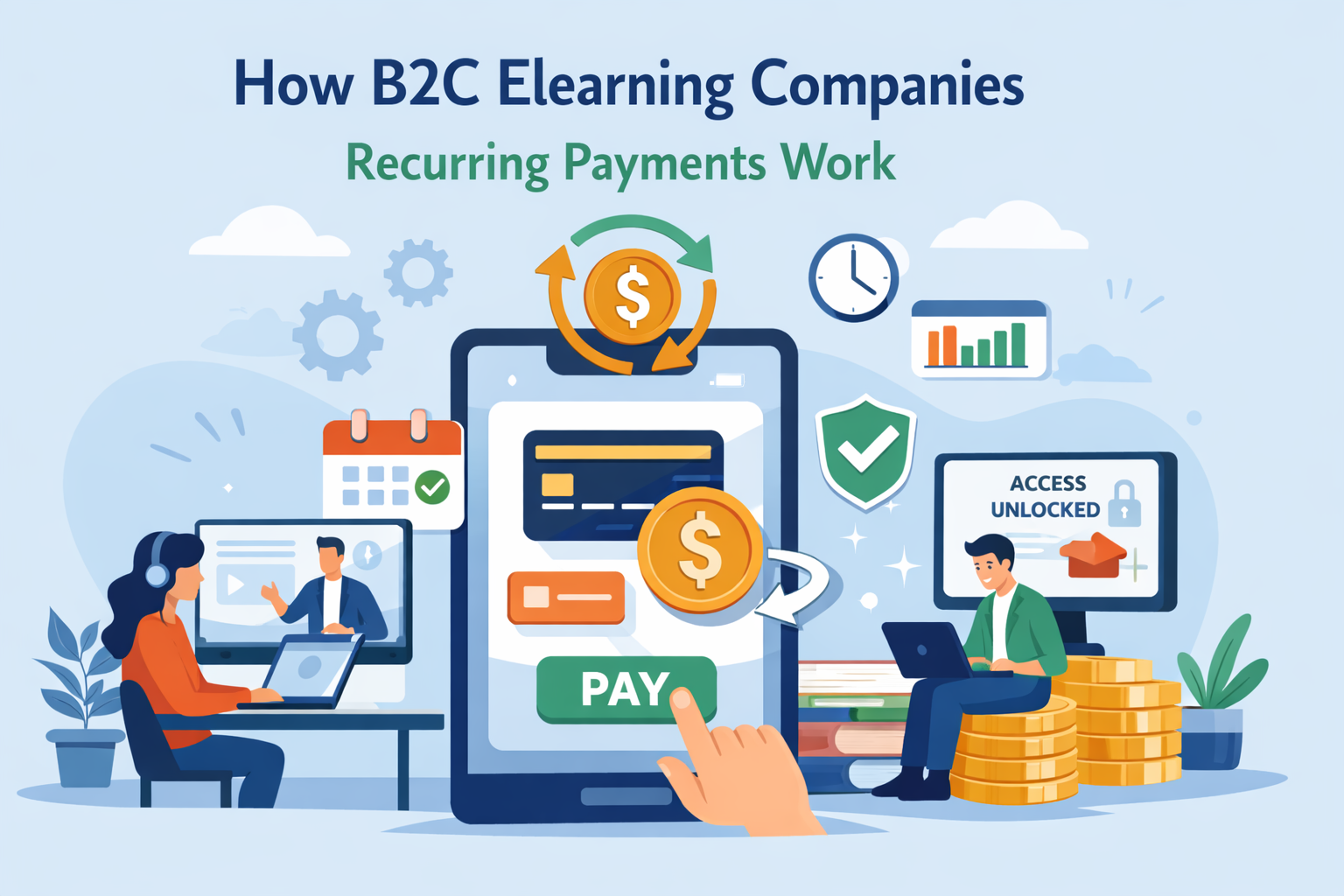
The online learning industry has changed how people build skills, earn certificates, and access education from anywhere. One of the biggest reasons for this growth is the subscription model, which makes learning more flexible and affordable for everyday users around the world.
That is where b2c elearning companies recurring payments come in. This model allows learning platforms to charge users automatically on a weekly, monthly, quarterly, or yearly basis. It creates a steady system for both the company and the learner, making education easier to deliver and easier to access.
Introduction
The phrase b2c elearning companies recurring payments refers to online education businesses that sell directly to individual users and collect payment on a repeating schedule. Instead of asking customers to buy every course separately, these companies often offer subscription plans for continuous access.
This approach has become highly popular because it supports convenience and long-term engagement. Learners can keep studying without interruption, while companies can build stable revenue streams that help them invest in better lessons, improved technology, and stronger customer experiences.
What Are B2C Elearning Companies?
B2C stands for business-to-consumer. In the elearning world, it describes companies that provide educational products or services directly to individual learners rather than schools, universities, or corporate teams. Their goal is to attract everyday users who want to learn for personal or professional growth.
These platforms may offer language lessons, coding classes, design tutorials, exam preparation, business training, or hobby-based content. Unlike B2B learning companies, which usually serve organizations, B2C elearning companies focus on user-friendly experiences, affordable plans, and strong marketing that appeals to individual needs.
Understanding Recurring Payments in Elearning
Recurring payments are automatic charges collected at regular intervals. Once a learner subscribes and enters payment details, the platform charges them again according to the selected billing cycle. This can happen every month, every three months, or once a year.
In elearning, recurring billing works especially well because education often happens over time. Learners usually need continued access to videos, quizzes, community support, downloadable materials, and new lessons. A recurring payment model supports that ongoing relationship without requiring users to make repeated manual purchases.
Why B2C Elearning Companies Use Recurring Payments
One major reason these companies rely on recurring payments is predictable income. Instead of depending only on one-time sales, they can estimate future revenue more accurately. This helps with budgeting, content creation, marketing decisions, and platform improvements.
Recurring payments also support stronger customer retention. When learners stay subscribed, they are more likely to explore more lessons, complete courses, and remain engaged with the platform. This creates a better opportunity for brands to build trust and long-term loyalty.
Common Subscription Models Used by B2C Elearning Companies
Many platforms offer monthly subscriptions because they are simple and affordable for new users. A learner can join with a low upfront cost, test the platform, and decide whether it meets their goals. This model is ideal for people who want flexibility.
Other companies use annual memberships, freemium upgrades, or tiered plans. An annual plan usually costs less over time and encourages longer commitment. Tiered plans may unlock premium courses, coaching sessions, certificates, or community access depending on the price level.
How the Recurring Payment Process Works Step by Step
The process usually begins when a user chooses a plan and creates an account. They enter payment information, review the billing terms, and confirm the subscription. At that point, the system stores the agreement and schedules future payments automatically.
When the renewal date arrives, the billing platform attempts to charge the saved payment method. If the transaction is successful, the learner keeps access without interruption. If it fails, the system may retry the charge, send reminders, or ask the user to update payment details.
Payment Gateways and Billing Systems Behind Recurring Payments
Behind the scenes, recurring payments depend on payment gateways and subscription billing systems. A payment gateway securely handles the transaction between the user, the platform, and the bank. It helps process charges safely and quickly while protecting financial data.
Billing software manages the larger subscription workflow. It tracks plan types, billing dates, invoices, retries, discounts, taxes, and cancellations. For B2C elearning companies, this automation reduces manual work and allows teams to focus more on learning content and customer support.
Benefits of B2C Elearning Companies Recurring Payments for Learners
For learners, recurring payments make online education easier to access. Instead of paying a large one-time price, users can spread the cost over time. This lowers the barrier to entry and makes premium learning more realistic for students, freelancers, and professionals.
Another major benefit is uninterrupted learning. Subscribers can continue lessons, monitor progress, and use platform features without stopping to repurchase access. This smoother experience helps learners stay focused on improvement rather than worrying about repeated payment steps.
Business Benefits of B2C Elearning Companies Recurring Payments
For companies, recurring payments create dependable cash flow. A stable income base makes it easier to plan product updates, launch new courses, hire instructors, and invest in customer acquisition. This financial visibility is especially useful for growing elearning brands.
This model also improves customer lifetime value. A learner who remains subscribed for several months or years becomes more valuable than a one-time buyer. Over time, the company can build stronger relationships, encourage upsells, and create a more sustainable business structure.
Challenges in Managing B2C Elearning Companies Recurring Payments
Even though the subscription model is powerful, it comes with challenges. Failed payments can happen because of expired cards, insufficient funds, or banking issues. If not handled properly, these failed transactions can lead to lost revenue and interrupted access for learners.
Customer churn is another major challenge. Some users cancel because they lose interest, do not use the platform enough, or find a competing service. Others may become confused by unclear billing terms, which can harm trust and create unnecessary refund requests.
How B2C Elearning Companies Reduce Payment Failures and Churn
To reduce failed payments, companies often use automatic retries and reminder emails. If a charge does not go through on the first attempt, the system may try again after a short delay. This simple process can recover revenue without creating friction for the customer.
To reduce churn, successful platforms keep users engaged with fresh content, personalized recommendations, achievement tracking, and loyalty offers. When learners feel they are making progress and receiving real value, they are more likely to continue their subscription.
Best Practices for Building a Strong Recurring Payment Strategy
A strong recurring payment strategy starts with transparency. Companies should clearly explain pricing, billing frequency, renewal dates, cancellation policies, and refund terms. Honest communication reduces confusion and builds trust, which is critical in a subscription-based learning business.
It is also important to track performance metrics such as churn rate, renewal rate, average revenue per user, and customer lifetime value. These numbers help companies understand what is working, where users are dropping off, and how the subscription experience can improve.
The Future of B2C Elearning Companies Recurring Payments
The future of b2c elearning companies recurring payments looks strong because digital learning continues to expand. More people now want flexible, affordable, and on-demand education. Subscription models match that demand by giving users continuous access to evolving content and useful learning tools.
As technology improves, recurring payment systems will likely become even smarter and more personalized. Companies may offer better plan customization, localized pricing, smoother renewals, and stronger retention strategies. This means the subscription model will continue shaping the future of online education.
Final Thoughts
Understanding b2c elearning companies recurring payments is important for anyone interested in the business side of online learning. This model is not only about automated billing. It is about creating a long-term connection between a platform and the learner.
When managed well, recurring payments help learners enjoy convenience and consistent access while giving companies predictable revenue and growth opportunities. That balance is one of the main reasons subscription-based elearning has become such a powerful force in the digital education industry.
