


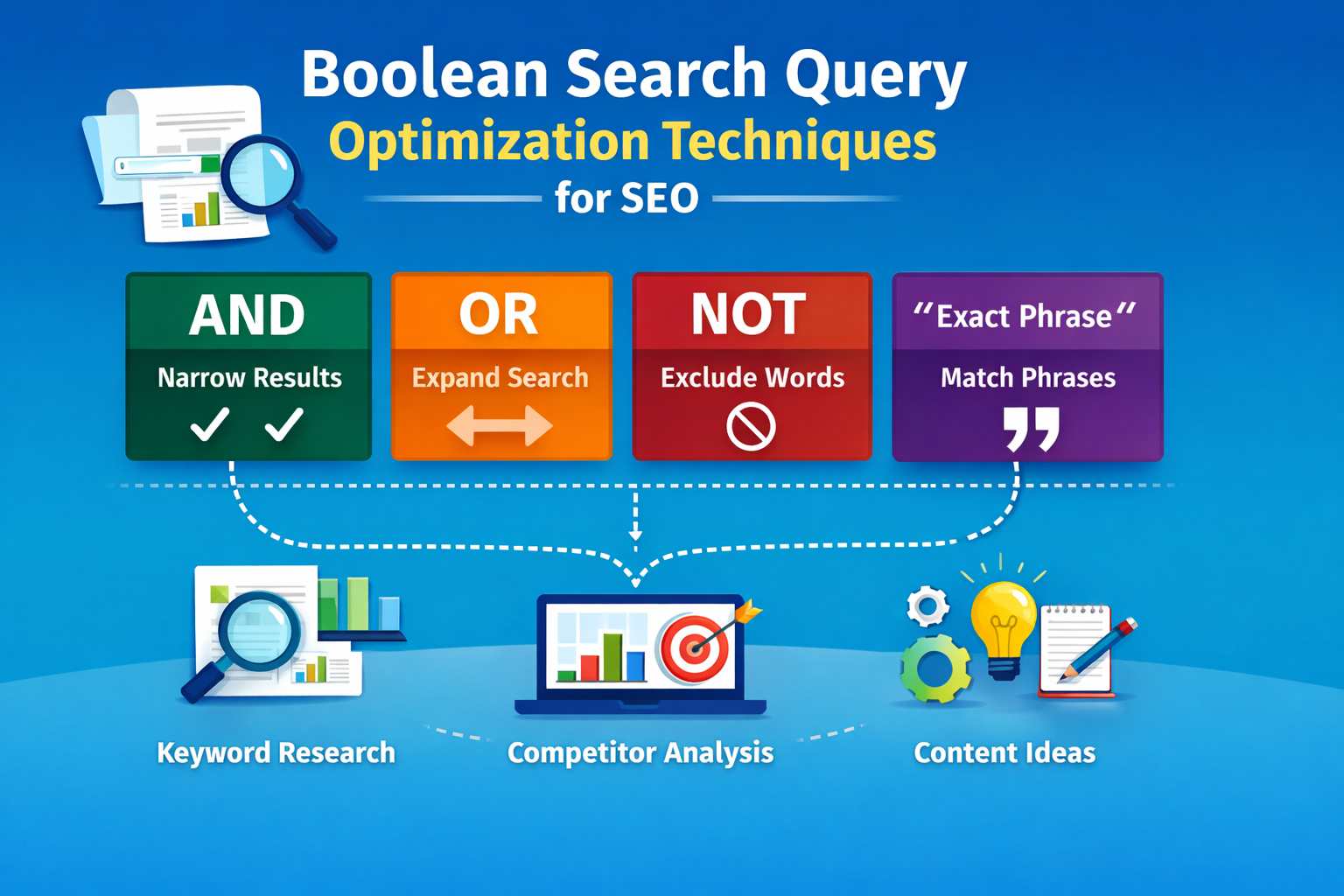
Boolean search query optimization techniques for SEO help marketers search with greater precision, control, and speed. Instead of typing random phrases into search engines or SEO tools, you can build smarter queries that uncover the exact information you need.
These techniques are useful for keyword research, competitor analysis, content ideation, link building, and search intent discovery. When used correctly, Boolean logic turns basic searches into highly targeted research methods that support stronger SEO strategies and better content planning.
What Are Boolean Operators?
Boolean operators are words and symbols that define the relationship between search terms. The most common ones are AND, OR, and NOT, along with quotation marks and parentheses for exact matching and grouping.
In SEO, Boolean operators help refine how results are displayed. They allow you to combine related keywords, exclude irrelevant topics, and structure complex research queries in a way that saves time and improves the quality of your findings.
Why Boolean Search Query Optimization Techniques Matter for SEO
SEO depends on relevance, intent, and accurate data. Boolean search query optimization techniques matter because they reduce noise and help marketers focus on high-value information instead of sorting through pages of unrelated search results.
They also improve productivity. Whether you are researching content opportunities or analyzing competitors, Boolean logic helps you move faster from raw search results to actionable insights. That means better decisions, sharper strategy, and stronger optimization outcomes.
Core Boolean Search Query Optimization Techniques
Using AND for Narrow Search Intent
The AND operator is used to combine two or more terms that must appear together. This is helpful when you want highly focused search results around a specific topic, niche, or keyword combination.
For example, searching SEO AND content marketing narrows the results to pages that discuss both topics together. This technique works well when researching overlapping concepts, industry-specific strategies, or detailed topic clusters for organic search campaigns.
Using OR to Expand Keyword Discovery
The OR operator broadens your search by allowing either one term or another to appear in results. This is useful for discovering synonyms, alternate phrases, and long-tail keyword variations that may not use the exact same wording.
For instance, “keyword research” OR “search term analysis” can reveal different types of content targeting similar intent. In SEO, this helps uncover multiple ways audiences describe the same problem, product, or service across search platforms and websites.
Using NOT to Remove Unwanted Results
The NOT operator excludes terms that you do not want in your search results. This is especially useful when a keyword has multiple meanings or when a topic overlaps with unrelated industries.
For example, if you search jaguar NOT car, you are more likely to see results about the animal instead of the vehicle brand. In SEO, this helps eliminate distractions and focus only on the content that matches your actual research goal.
Using Quotation Marks for Exact Match Searches
Quotation marks are essential when you want exact phrase matching. They tell the search engine or tool to find results containing the phrase exactly as written, rather than pages that include the individual words in random order.
For SEO professionals, this is useful when checking title usage, keyword repetition, branded mentions, or exact search phrases. If you search “Boolean search query optimization techniques”, you can evaluate how many pages directly target that phrase and how strong the competition may be.
Grouping Terms with Parentheses for Better Query Structure
Parentheses help organize complex searches by grouping related terms together. This makes long queries easier to read and ensures the search engine interprets your intent more accurately when several operators are used at once.
For example, (SEO OR “search engine optimization”) AND (content OR blog) gives a clearer structure than mixing all terms together without grouping. In SEO research, parentheses make complex keyword discovery and competitor tracking more logical and effective.
Boolean Search Query Optimization Techniques for Keyword Research
Keyword research becomes much more effective when Boolean logic is applied. Instead of relying on a single phrase, you can build layered queries that explore related terms, commercial language, informational intent, and audience-specific wording.
For example, a search like (best OR top OR affordable) AND SEO tools can reveal common modifiers used in buying-intent content. This helps marketers identify high-value phrases, content angles, and semantic opportunities that can support stronger keyword targeting.
Boolean searches also help with long-tail keyword discovery. You can combine industry terms with questions, problems, or audience needs to find topic ideas that match real search intent more closely than broad seed keywords alone.
A query such as (how OR why OR what) AND technical SEO may uncover question-based content themes for blogs, FAQs, or featured snippet optimization. This makes Boolean logic especially powerful when building content hubs and topic clusters.
Using Boolean Search Query Optimization Techniques for Competitor Analysis
Competitor analysis is another area where Boolean search becomes highly valuable. You can combine brand names, products, services, or content themes to study what competitors are publishing and how they position themselves in organic search.
For example, a search such as “competitor brand” AND blog can reveal content strategy patterns. Adding terms like guide, case study, or pricing can further expose the types of landing pages or articles they prioritize for visibility.
Boolean logic also helps identify gaps between your site and competing sites. By comparing categories, topics, and keyword usage, you can discover missed opportunities where competitors rank and your content is either weak or missing entirely.
This can support content expansion, internal linking improvements, and search intent refinement. Instead of copying competitors, you gain a clearer map of the search landscape and build smarter pages that offer stronger depth, clarity, and value.
Boolean Search Query Optimization Techniques for Content Ideation
Content ideation often becomes repetitive when marketers rely on basic brainstorming. Boolean search adds structure to the process by uncovering how topics are discussed online, what wording is trending, and which angles appear most often.
For example, searching (tips OR guide OR strategy) AND local SEO can show how publishers frame similar content. This helps you identify common patterns, then create a unique piece that fills a gap or improves on what already exists.
It also helps generate article titles, supporting headings, and related subtopics. By mixing pain points, benefits, and action terms, Boolean logic can uncover the language your target audience already uses in search-friendly content.
A search like (mistakes OR checklist OR examples) AND on-page SEO can inspire blog posts, tutorials, and lead magnets. That makes Boolean search a practical tool not only for research, but also for consistent editorial planning.
Advanced Boolean Search Query Optimization Techniques for SEO
Combining Operators in Complex Queries
Advanced Boolean search query optimization techniques involve combining multiple operators within one query. This allows you to build highly specific searches that reflect nuanced intent and uncover deeper insights from search engines and SEO tools.
For example, (SEO OR PPC) AND (strategy OR plan) NOT agency can narrow results to educational content rather than service pages. This approach is useful for advanced research, niche analysis, and identifying content patterns within highly competitive topics.
Using Boolean Search with SEO Footprints
SEO footprints are special words or patterns that help locate certain types of pages. When used with Boolean logic, they become powerful for finding guest post opportunities, resource pages, niche blogs, and content submission sites.
A search like (“write for us” OR “guest post”) AND SEO can quickly reveal websites that accept contributed content. This is useful for link building, digital PR, and outreach campaigns that depend on finding relevant publishing opportunities.
Applying Boolean Logic Across SEO Tools
Boolean logic is not limited to Google. Many SEO tools, content databases, social platforms, and recruitment systems allow some form of Boolean searching to filter data and improve result relevance.
This means marketers can use Boolean strategies in keyword platforms, content research tools, and even prospecting systems. Understanding how each platform handles operators gives you an advantage in data collection, filtering, and competitive discovery.
Common Mistakes to Avoid
One common mistake is making queries too complex too early. Overloaded search strings can become confusing and may produce fewer useful results than a simpler, more focused search with one clear objective.
Another mistake is ignoring search intent. Even if the query structure is technically correct, the results may still miss the mark if the chosen keywords do not match informational, commercial, or transactional goals.
Some users also overuse the NOT operator and remove potentially useful pages. While exclusions are helpful, too many restrictions can block relevant results and create blind spots in your SEO research process.
It is also easy to forget exact match opportunities. Without quotation marks, searches may become too broad. Testing multiple versions of a query often reveals which structure delivers the most useful and reliable information.
Best Practices for Using Boolean Search Query Optimization Techniques for SEO
The best way to start is with a broad search, then refine it gradually. Begin with the core topic, observe the result patterns, and then add operators to narrow or expand your query based on what you learn.
Keep your keyword goal clear before building the search. Are you looking for blog ideas, ranking competitors, guest post sites, or keyword variations? A clear objective leads to better Boolean structures and stronger SEO outcomes.
It is also wise to test multiple query versions. Small changes in wording, grouping, or phrase matching can dramatically change the quality of results. Document your best-performing patterns so you can reuse them in future SEO campaigns.
Finally, align Boolean search activity with your broader SEO strategy. The goal is not just finding information. The real purpose is turning search data into optimized content, smarter targeting, and better visibility in organic search.
Conclusion
Boolean search query optimization techniques for SEO offer a practical way to search with more intelligence and less guesswork. They improve how you discover keywords, study competitors, plan content, and locate targeted opportunities online.
As SEO becomes more competitive, the ability to refine search behavior becomes increasingly valuable. Mastering Boolean logic gives you a flexible skill that strengthens research quality, improves strategic clarity, and supports long-term organic growth.
With regular use, these techniques become second nature. Over time, you will be able to create better queries faster, uncover more relevant insights, and build a stronger SEO workflow based on accuracy, efficiency, and purposeful search intent.
