


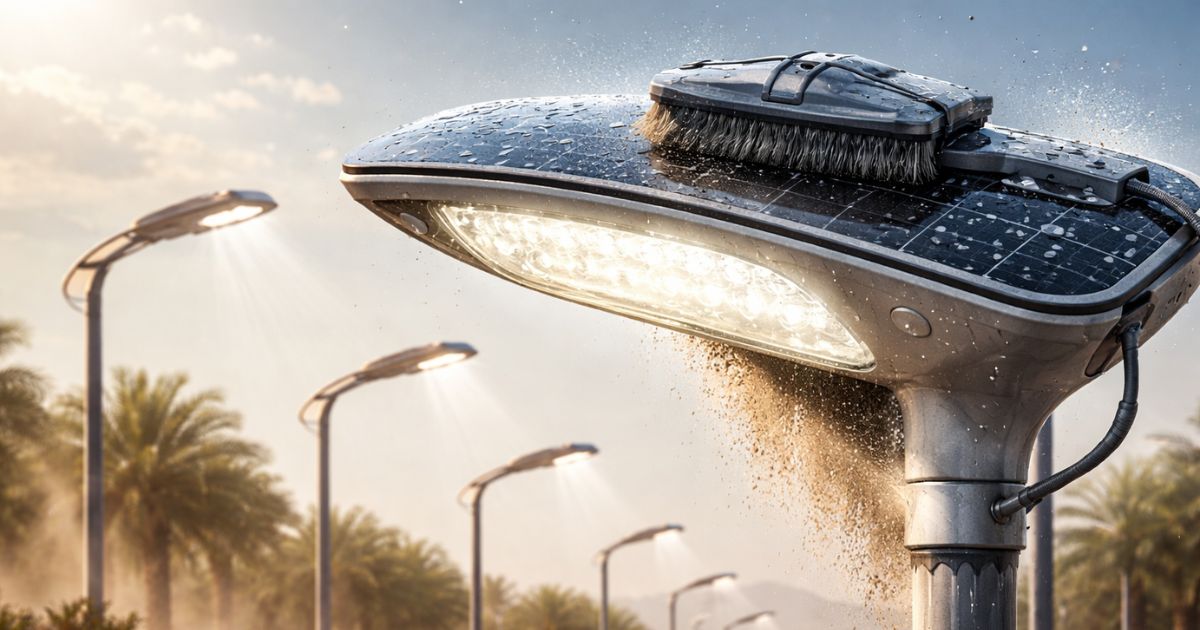
Dust is one of the most ignored “silent killers” of street lighting. When grime builds up on lenses, covers, and solar panels, the light output drops and roads feel darker, even though electricity costs stay the same.
That’s why searches like “self cleaning street lamp research dust resistant lamp project exist” are rising. People want to know if a real solution exists, or if it’s just marketing talk dressed up as innovation.
What “Self-Cleaning” Street Lamps Actually Mean
A self-cleaning street lamp doesn’t mean the lamp magically washes itself like a car in a tunnel. Usually, it means the lamp uses smart materials or design so dust doesn’t stick easily, or it gets removed naturally by rain, wind, or light.
Dust-resistant is also different from dust-proof. Dust-resistant design reduces buildup and slows performance loss. Dust-proof suggests total protection, which is rare outdoors. In practice, most “self-cleaning” systems aim to reduce cleaning frequency, not eliminate it.
Main Problems Dust Causes in Street Lighting
Dust isn’t just ugly—it’s expensive. A thin film on the lens reduces brightness, which can create dark patches on roads. Cities then compensate by increasing wattage, wasting energy while still failing to restore the original clarity.
Dust also affects heat management. When covers are dirty or airflow is blocked, LEDs can run hotter. Higher heat accelerates lumen depreciation and can shorten driver life, increasing failure rates, maintenance visits, and replacement costs over time.
Does self cleaning street lamp research dust resistant lamp project exist?
Yes, it exists in multiple forms—research papers, patents, prototypes, and real products—especially in harsh environments like deserts, industrial zones, and coastal roads. The key is that “exist” depends on what you call a project: lab research or field-ready deployment.
Many projects target solar street lights first because dust reduces both charging and lighting. Some are municipal pilots, while others are commercial systems sold as “automatic cleaning” or “anti-soiling” upgrades. The most realistic solutions combine materials plus smart design.
Technology 1: Self-Cleaning Coatings (Passive Cleaning)
Passive self-cleaning coatings are like giving the lamp cover a special skin. Some coatings are hydrophilic, meaning water spreads into a thin sheet rather than forming droplets. When it rains, water can wash away dust more evenly, leaving fewer streaks.
Another approach uses photocatalytic coatings, often based on titanium dioxide. Sunlight helps break down certain organic grime, and the surface becomes easier to rinse clean. For street lamps, these coatings are attractive because they add no moving parts and need no power.
Technology 2: Hydrophobic & Anti-Soiling Surfaces (Dust Repellent)
Hydrophobic and anti-soiling surfaces try to reduce how strongly dust clings. In dry climates, dust sticks through electrostatic attraction and micro-texture friction. Anti-soiling coatings can lower adhesion, making wind, vibration, or light rainfall enough to remove some buildup.
However, the real challenge is durability. Outdoor lenses face UV exposure, sand abrasion, and chemical pollution. A coating that performs well in a lab may degrade after months of real weather. Long-life outdoor coatings need strong bonding, scratch resistance, and consistent optical clarity.
Technology 3: Electrostatic & Vibration Cleaning (Active Cleaning)
Electrostatic dust removal uses controlled electric fields to push dust particles off a surface. It’s common in research for solar panels and sensors. For street lamps, the idea is to use a low-energy field periodically to “shake loose” dust without physical contact.
Vibration-based methods use micro-vibrations to discourage dust settlement or to dislodge particles. In theory, it’s elegant. In practice, engineers must balance power consumption, long-term reliability, and noise. Still, in extremely dusty regions, active cleaning can outperform coatings alone.
Technology 4: Mechanical Wipers & Brush Systems (Mostly for Solar Street Lights)
Mechanical systems are the most visible “self-cleaning” option: a brush, wiper, or sliding cleaner sweeps over a solar panel or lamp cover on a schedule. These are popular where dust is heavy and predictable, like desert highways or construction corridors.
But moving parts bring new problems. Brushes can wear down, motors can fail, and sand can grind gears. If the cleaning mechanism breaks, maintenance becomes more complex than normal washing. Mechanical solutions work best when designed for quick servicing and rugged, sealed components.
Smart Design: Dust-Resistant Lamp Housing & Engineering
Dust resistance isn’t only about coatings. Housing design matters. A well-sealed enclosure with proper gaskets and vents reduces how much dust enters sensitive areas. High IP-rated designs can protect electronics, while pressure equalization vents reduce condensation without inviting dirt.
Lens geometry also helps. Smooth, angled covers can shed dust better than flat surfaces. Materials matter too: tempered glass resists scratching and stays clearer longer, while polycarbonate can yellow or micro-scratch. Great design reduces dust accumulation before cleaning is even needed.
Real-World Use Cases & Example Project Scenarios
In desert regions, dust storms can cut light output dramatically in a short time. Projects here often use a hybrid approach: anti-soiling coatings plus periodic mechanical cleaning for solar panels. The goal is consistent illumination and reliable charging without constant human labor.
Coastal areas face salt spray mixed with dust, creating a sticky film that’s harder to remove. Industrial zones add soot, oils, and chemical particles. Each environment needs a different strategy, which is why a “one coating fits all” claim is often unrealistic in real streets.
How to Evaluate a “Project Exists” Claim
To judge whether a self-cleaning street lamp claim is real, look for measurable proof. Field trials should report lumen maintenance over time, cleaning intervals, and weather exposure. Research papers and patents help, but real performance data matters most for cities.
Watch for red flags like vague phrases: “advanced nano-coating” with no durability specs, or “100% dust-proof” without test standards. A credible project will state optical transmission changes, abrasion resistance, UV aging results, and maintenance requirements in plain terms.
Cost, ROI, and Maintenance Planning
Self-cleaning features can raise upfront cost, but they can lower long-term spending. The ROI depends on labor costs, access difficulty, and dust severity. If a lamp is on a remote highway, avoiding frequent cleaning trips can quickly justify better materials.
A realistic plan includes scheduled inspections, not blind trust. Even passive coatings benefit from occasional rinsing. Mechanical systems need checks for wear. The smartest approach is preventive maintenance: monitor brightness decline, inspect after storms, and replace worn cleaning components before failures spread.
Conclusion
So, self cleaning street lamp research dust resistant lamp project exist is not just a question—it’s a real category of innovation. Research and products do exist, but the best solution depends on environment. Coatings excel for low-maintenance simplicity; mechanical cleaning wins in heavy dust.
If you’re writing or building a project, start by defining the dust type, climate, and maintenance limits. Then explore hybrid designs: durable lens materials, anti-soiling coatings, smart housing geometry, and optional active cleaning for extreme conditions. That’s where “exists” becomes “works.”
