


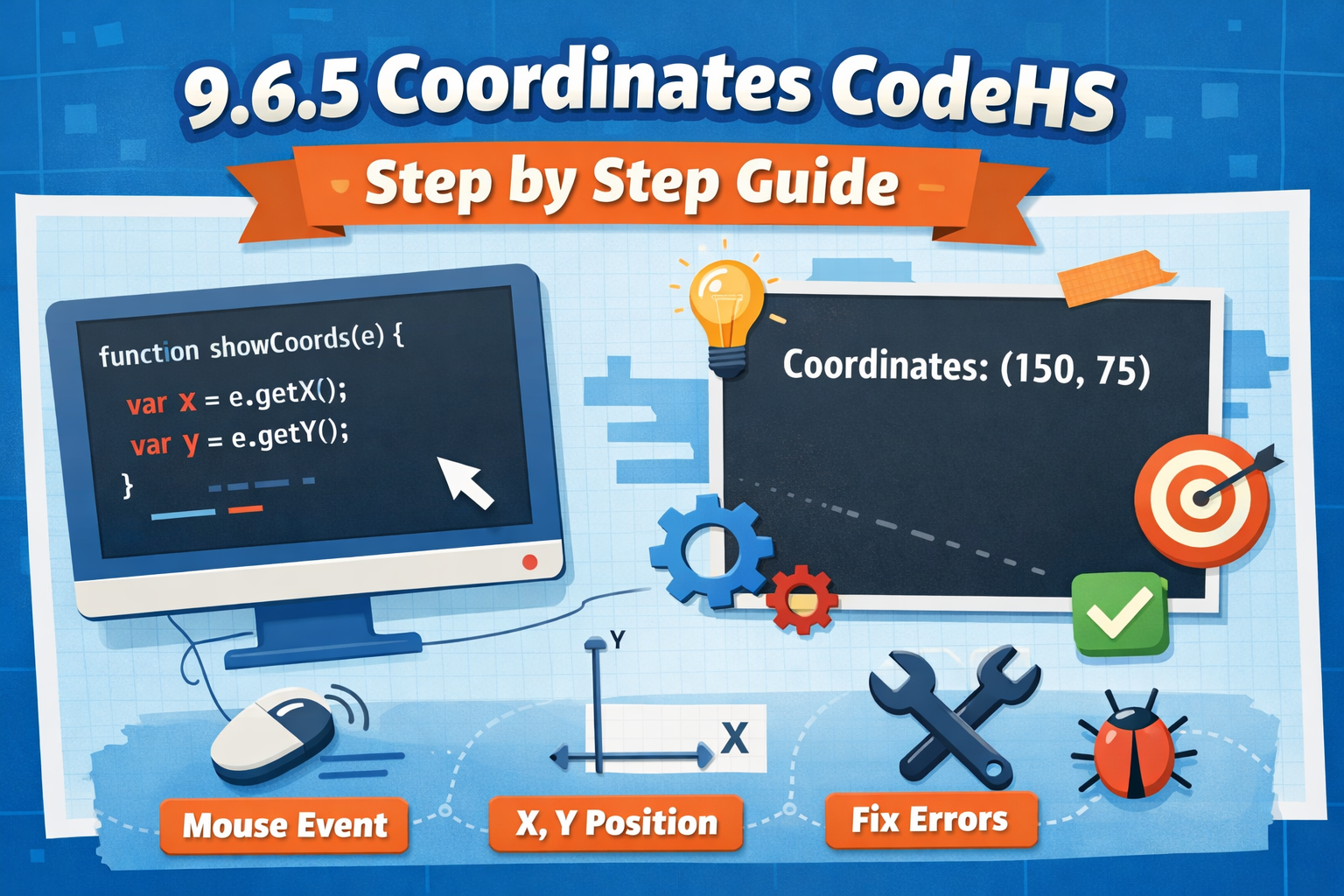
Many students look for help with 9.6.5 coordinates codehs because it seems simple at first, yet it often becomes confusing during practice. The task usually asks you to work with mouse movement, coordinate values, and on-screen text in a way that feels new to beginners.
This guide explains the lesson in a clear and friendly way. Instead of rushing through code, it focuses on the ideas behind the exercise, the common mistakes students make, and the logic needed to complete the challenge with confidence.
What Is 9.6.5 Coordinates CodeHS?
The 9.6.5 coordinates codehs exercise is commonly part of a CodeHS JavaScript lesson that introduces mouse events and coordinate tracking. In most versions of this task, the goal is to show the mouse position on the canvas as the user moves the cursor.
That means the program must react in real time. As the mouse moves, the x-coordinate and y-coordinate change, and the program updates the display to reflect the current location. It is a practical lesson that connects coding to visible screen interaction.
Why This Exercise Matters in CodeHS
This exercise matters because it teaches how programs respond to user behavior. Instead of writing code that runs once and stops, students begin working with interactive programming, where actions like moving the mouse trigger changes on the screen.
It also builds a foundation for later projects. Once you understand coordinate tracking, you can create drawing tools, games, hover effects, and other interactive designs. That is why 9.6.5 coordinates codehs is more than a small assignment; it is a basic skill-building step.
Key Concepts You Need to Understand First
Before solving the problem, it is important to understand two main ideas: coordinates and mouse events. These concepts may sound technical, but they are actually very visual and easy to grasp once explained properly.
When these two ideas come together, the lesson becomes much easier. The program is simply watching where the mouse is and then converting that location into values the computer can display.
What Are Coordinates?
Coordinates are numbers that tell you where something is located on the screen. The x-coordinate measures horizontal position, while the y-coordinate measures vertical position. Together, these values describe an exact point on the canvas.
If the mouse is near the left side, the x-value will be small. If it moves toward the right side, the x-value increases. The same logic applies to the y-value, which changes as the cursor moves up or down.
What Are Mouse Events?
Mouse events are actions the program can detect from the user’s mouse. These include clicking, moving, dragging, and entering certain parts of the screen. In this lesson, the key event is mouse movement.
When the mouse moves, the program receives an event object. That object often contains useful information such as the current x and y position. This is how the program knows what coordinates to display.
Tools and Functions Used in 9.6.5 Coordinates CodeHS
To complete 9.6.5 coordinates codehs, students usually use a few important functions and objects. One of the most common is a function that listens for mouse movement and calls another function whenever the cursor changes position.
You may also use methods like e.getX() and e.getY() to read the mouse position from the event object. A text object is then created to show those values on the canvas. These tools work together to produce the final result.
Understanding the Goal of the Program
The main goal of the program is to display the mouse coordinates while the cursor moves across the canvas. As the position changes, the values shown on the screen must also change. This creates a live coordinate tracker.
In many versions of the exercise, the text should update cleanly rather than stacking over itself. That means the old coordinate text must be removed or replaced before the new text is added. This keeps the display readable and neat.
Step by Step Setup for the Exercise
The setup stage is where the structure of the solution begins. Even if the finished code is short, each line has a purpose. Starting with a clear plan makes the task much easier to understand and debug.
A good setup often includes creating a variable for the text display and writing a start() function that connects the mouse event to a custom function. These two actions form the base of the entire solution.
Creating the Main Variable
A variable is usually needed to keep track of the text object showing the coordinates. Without this variable, the program may keep creating new text without knowing which old text should be removed.
This variable acts like a label for the current coordinate display. Every time the mouse moves, the program can use that label to remove the previous text and replace it with an updated version.
Writing the start() Function
The start() function is where the program begins. In many CodeHS exercises, this function tells the canvas what event to listen for and what function should run when that event happens.
For this lesson, the start() function often connects mouse movement to a coordinate-display function. Once that connection is made, the program starts reacting every time the mouse changes position on the screen.
How to Display Coordinates on the Screen
Displaying coordinates usually involves creating a text object that combines the x-value and y-value into a readable format. For example, the output might appear like this: (120, 85) on the canvas.
After the text is created, it needs a position on the screen. Most students place it in a fixed corner so it remains visible at all times. Then the text object is added to the canvas so the user can see it immediately.
How to Update Coordinates Without Overlapping Text
One of the most common issues in 9.6.5 coordinates codehs is overlapping text. When students add new coordinate text every time the mouse moves but do not remove the old one, the screen quickly becomes cluttered and messy.
The solution is simple in logic. Before adding the new text object, remove the previous one if it already exists. Then add the updated version. This creates the appearance of one smooth coordinate label instead of dozens of stacked lines.
Common Errors in 9.6.5 Coordinates CodeHS
Beginners often make small mistakes in this lesson, but those mistakes can completely stop the program from working. The good news is that most of them are easy to fix once you know what to check.
Paying attention to function names, object methods, and update logic can save a lot of time. When a coordinate program fails, the problem is usually not advanced. It is often just one missing or misplaced detail.
Forgetting to Remove Old Text
This is one of the biggest beginner mistakes. The code may technically work, but the screen fills with old coordinate labels because nothing tells the program to clear the previous text before adding a new one.
When that happens, students think the whole solution is wrong, even though only one step is missing. Removing the old text first gives the display a polished and professional appearance.
Using the Wrong Event Methods
Another common issue is using the wrong method name or forgetting to include the event object in the function. If the function does not receive the event correctly, it cannot read the x and y position.
Small errors like writing the wrong capitalization or using incorrect syntax can break the solution. That is why checking method names carefully is an important part of solving 9.6.5 coordinates codehs successfully.
Positioning Text Incorrectly
Sometimes the text is created correctly but appears off-screen or too close to the edge. In that case, students assume the code failed when the real problem is simply poor placement.
Choosing a visible position, such as near the top-left corner, makes the output easy to test. Good placement also helps when you need to debug the program and confirm that the coordinates are updating properly.
Tips to Solve 9.6.5 Coordinates CodeHS Faster
A smart way to solve the problem faster is to break it into small parts. First, make sure the mouse event works. Then check if the coordinates are being read correctly. After that, focus on displaying and updating the text.
It also helps to read the instructions carefully and avoid rushing. Many students lose time by making changes too quickly without testing. When each step is tested one at a time, errors become easier to spot and correct.
Sample Solution Structure for Better Understanding
A typical structure for this exercise begins with a global variable for the coordinate text. Then the start() function sets up the mouse movement listener. After that, a custom function handles the event and updates the display.
Inside the custom function, the program often removes the old text, creates a new text object using the latest coordinates, sets its position, and adds it to the canvas. This structure is simple, logical, and beginner-friendly.
Here is a basic example of how that structure may look:
var coordText;function start() {
    mouseMoveMethod(showCoordinates);
}function showCoordinates(e) {
    if (coordText != null) {
        remove(coordText);
    }    coordText = new Text("(" + e.getX() + ", " + e.getY() + ")", "15pt Arial");
    coordText.setPosition(10, 20);
    add(coordText);
}
This code is easy to understand because each line has one clear purpose. It listens for mouse movement, reads the coordinates, removes the previous label, and displays the updated values in a fixed location.
Final Thoughts
The 9.6.5 coordinates codehs step by step guide teaches more than just how to show numbers on a screen. It introduces event-driven programming, real-time updates, and the importance of organizing logic in small, manageable steps.
Once you understand this exercise, your confidence grows. You begin to see that interactive programming is not mysterious at all. It is simply about listening for user actions and responding with clear instructions. With practice, lessons like 9.6.5 coordinates codehs become much easier and far more enjoyable.
